Operating Systems Laboratory
Faculty: Faculty of Computer and Information Sciences Laboratory Building
Location: 3rd Floor B3-05
Capacity: 75 Students
Responsible Faculty Members:
-
Assoc. Prof. Dr. Yasin ORTAKCI
-
Asst. Prof. Dr. Bilal YOUSFI
Laboratory Supervisor:
-
Research Assistant Kadriye KARADENİZ
Laboratory View
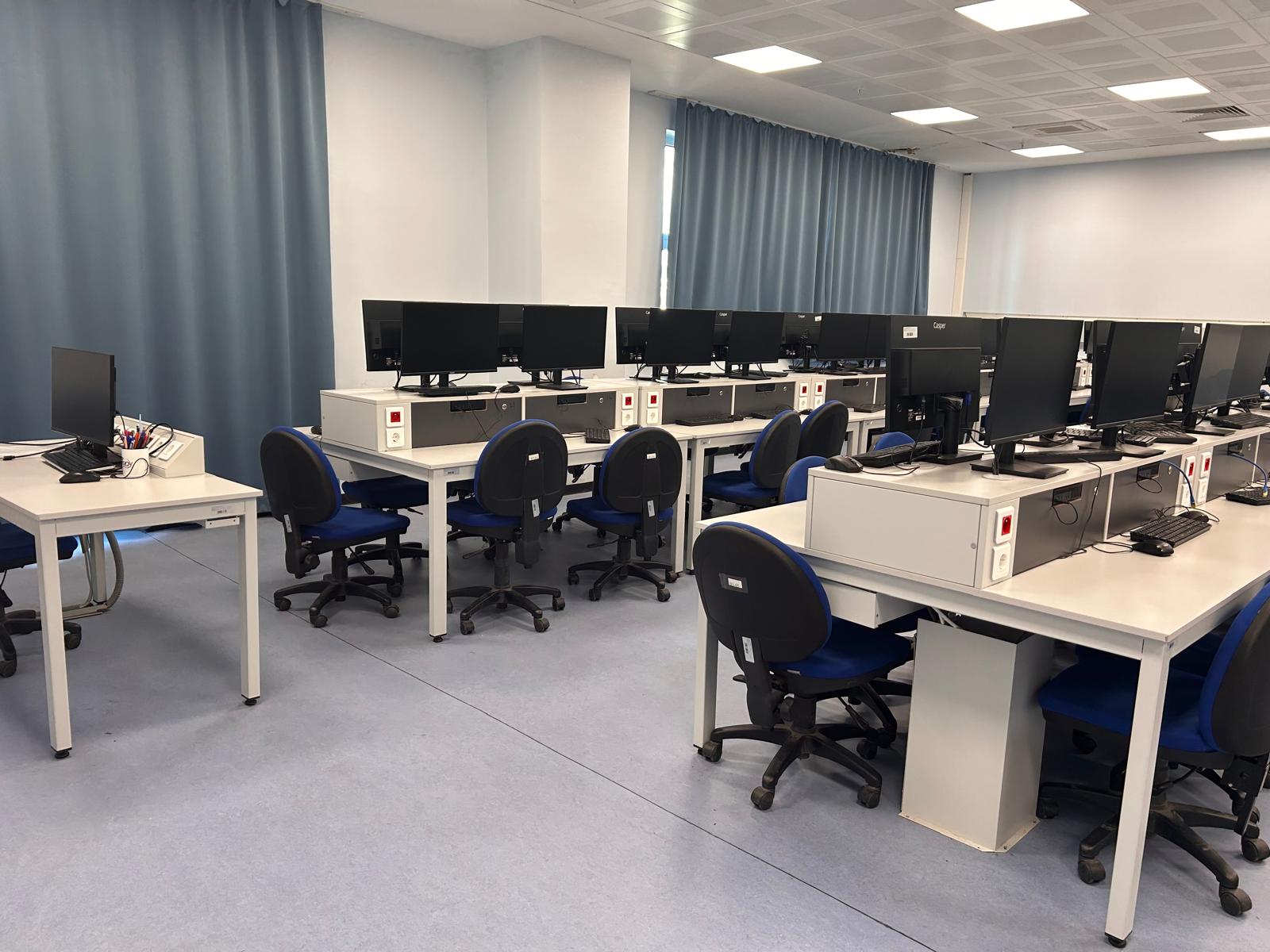 General view of Karabük University Faculty of Computer and Information Sciences – Operating Systems Laboratory.
Purpose of the Laboratory
The Operating Systems Laboratory aims for students to learn the fundamental concepts of operating systems, their operating mechanisms and resource management processes in a practical manner.
This laboratory enables the teaching of topics such as process management, memory management, file systems, concurrency, synchronization and basic kernel functions through simulations and programming applications. Additionally, students have the opportunity to experience terminal commands, system calls and shell scripting in the Linux environment.
Laboratory Usage Rules
-
The laboratory should only be entered during class or project hours, under the supervision of an instructor or authorized personnel.
-
Computers, network devices (switch, router, etc.) and cabling systems should only be used for experimental purposes. Connections should not be energized before the experiment without being shown to the instructor.
-
Approval must be obtained from the instructor before any connection or configuration process.
-
Unauthorized intervention in laboratory software, uploading personal files or changing internet settings is prohibited.
-
Each student must keep experiment reports regularly and submit them at the end of the course.
-
At the end of the experiment, connections must be disconnected, computers must be shut down and the desk arrangement must be maintained.
-
In case of damage to laboratory equipment or detection of failure, the situation must be reported to the responsible personnel immediately.
Areas of Use
-
Operating Systems course applications
-
Process and memory management experiments in Linux/Unix environment
-
System calls and shell scripting applications
-
Simulation of CPU scheduling algorithms (FCFS, SJF, RR, etc.)
-
Synchronization mechanisms (Semaphore, Mutex) experiments
-
File system structures and basic I/O operations applications
-
Virtual memory management and page replacement algorithms
-
Graduation projects and academic research
Learning Outcomes
Students who successfully complete this laboratory:
-
Explain the basic tasks of operating systems (resource management, multitasking, security).
-
Apply the concepts of process and thread and analyze their management.
-
Can simulate CPU scheduling algorithms and make performance comparisons.
-
Identify and solve synchronization and race condition problems.
-
Experimentally apply memory management, paging and virtual memory concepts.
-
Use Linux terminal commands effectively and acquire shell programming skills.
-
Understand the basic logic of system calls and kernel-level operations.
-
Develop problem solving, teamwork and technical reporting skills.