Faculty of Computer and Information Sciences Microcontrollers and Control Laboratory
Faculty: Faculty of Computer and Information Sciences Laboratory Building
Location: 3rd Floor A3-05
Capacity: 44 Students
Responsible Faculty Members:
-
Assoc. Prof. Dr. Funda DEMİR
-
Asst. Prof. Dr. Oğuzhan MENEMENCİOĞLU
Laboratory Supervisor:
-
Research Assistant Kadriye ÖZ
Laboratory View
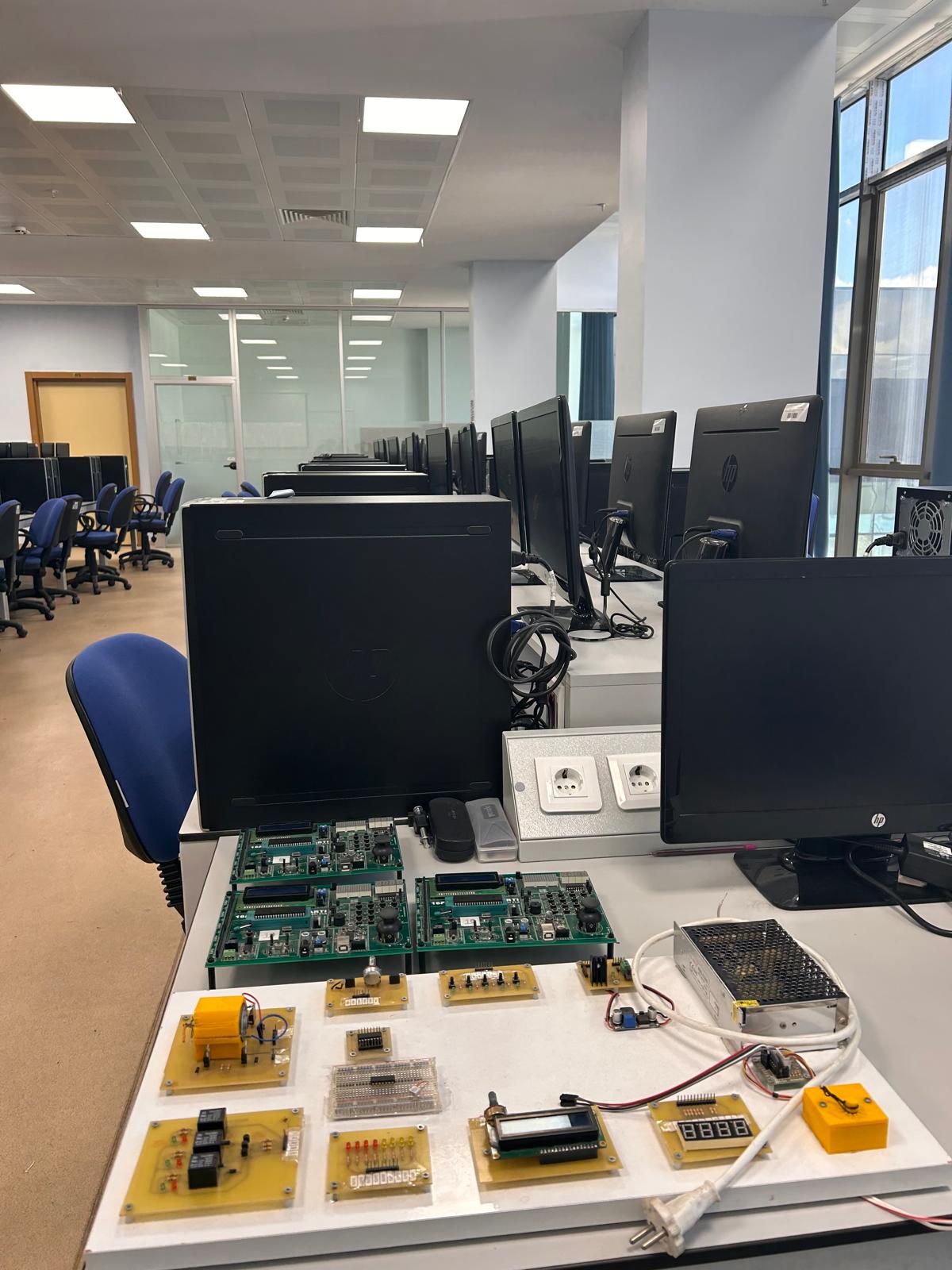 Faculty of Computer and Information Sciences – General view of Microcontrollers and Control Laboratory.
Purpose of the Laboratory
The Microcontrollers and Control Laboratory aims to teach students the fundamentals of microcontroller architectures, embedded systems and control applications experimentally. This laboratory enables students to gain practical skills in hardware-software integration, automatic control systems and sensor/actuator-based design.
Laboratory Usage Rules
-
Entry to the laboratory is only allowed during class hours or accompanied by authorized personnel.
-
Devices should only be used under the supervision of the assigned instructor or laboratory supervisor.
-
Circuit connections should not be energized without being shown to the instructor.
-
Students must keep a laboratory notebook for each experiment and record the results.
-
Device or equipment failure must be reported to the laboratory supervisor immediately.
-
At the end of the laboratory, the desk arrangement must be maintained and all systems must be shut down safely.
Areas of Use
-
Applications for Microcontrollers and Embedded Systems courses
-
PID, PWM, sensor-actuator based control experiments
-
Robotics and automation application projects
-
Graduation projects and research prototype studies
-
Test environment for IEEE student community and Teknofest projects
Learning Outcomes
-
Comprehends microcontroller architectures and basic peripheral units.
-
Can perform circuit design using input/output modules in embedded systems.
-
Can program microcontrollers with C/C++ or Assembly language.
-
Can perform data reading from sensors and actuator control.
-
Can test closed-loop (feedback) control principles practically.
-
Develops skills in working with real systems, debugging and project reporting.