Data Communication Laboratory
Faculty: Faculty of Computer and Information Sciences – Laboratory Building
Location: 3rd Floor B3-03
Capacity: 75 Students
Responsible Faculty Members:
-
Prof. Dr. İlhami Muharrem ORAK
Laboratory Supervisor:
-
Research Assistant Melek ŞENTÜRK
Laboratory View
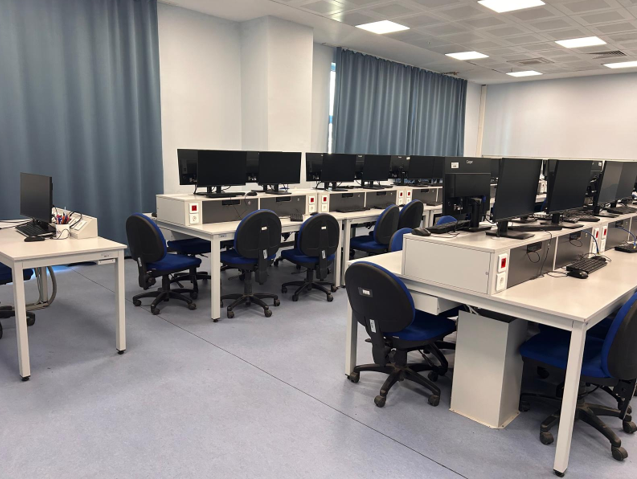 General view of Karabük University Faculty of Computer and Information Sciences – Data Communication Laboratory.
Purpose of the Laboratory
The Data Communication Laboratory provides an environment where students are taught computer networks, communication protocols and data transmission techniques in a practical manner. The laboratory enables experimental studies on topics such as establishing network topologies, analyzing data packets, and examining routing and switching systems. Additionally, it aims for students to learn fundamental communication concepts such as TCP/IP architecture, wired and wireless network configuration, signal transmission and error control in practice.
Laboratory Usage Rules
-
Entry to the laboratory is only allowed during class hours or accompanied by authorized personnel.
-
Network devices, routers and switches should only be used with the instructor's permission.
-
After each experiment, connections must be disconnected in an orderly manner, and the desk and cable arrangement must be maintained.
-
Experiments conducted must be recorded and results entered in the laboratory notebook.
-
Network connection or device failures must be reported to the responsible personnel immediately.
-
Connection of personal devices to the network in the laboratory can only be done with permission.
Areas of Use
-
Applications for computer networks and communication courses
-
Routing and switching protocol experiments
-
Packet analysis and network performance measurement with Wireshark
-
Secure data transmission and encryption applications
-
Graduation projects and IEEE student studies
-
Testing IoT (Internet of Things) network scenarios
Learning Outcomes
-
Comprehends data communication and network concepts experimentally.
-
Performs routing, switching and addressing operations in practice.
-
Can configure network devices and solve connection problems.
-
Analyzes data transmission performance on different topologies.
-
Can effectively use protocol analysis tools (Wireshark, etc.).
-
Designs secure and efficient communication structures on real systems.